


Polymerase Chain Reaction
Making DNA accessible
Most people in molecular biology today are not old enough to remember pre-PCR. But try to do your job without it, and you will see what a difference that simple little technique has made.
'Polymerase Chain Reaction' is now a word in Merriam Webster's Collegiate Dictionary and if you put 'PCR' into Google, you get 18,000,000 hits. If you type in 'pcr song,' you get a lovely little ditty courtesy of Bio-Rad, which will rattle around in your brain like an insane cat in your garage. Try it.
When I stumbled on PCR in the spring of 1983, I was trying to increase the demand for oligonucleotides, which before automation my laboratory had made by hand. Our new machine from my friend Ron Cook at Biosearch across the San Francisco bay had threatened job stability in the laboratory by doing what had taken us about three weeks to do, in eight hours—and it did it every eight hours, no breaks.
My attempt succeeded. The demand went up by about a million and I didn't have to fire any of my fellow lab workers at Cetus.
I was driving up a long and winding road between Cloverdale and Booneville in Mendocino County, heading for my weekend cabin. My girlfriend was asleep and I was functionally sober (or the road would have proven my undoing) but it was late at night and I was feeling weird. Strange things had happened to me on 128 before. Furtive old men in…what was that? A grey robe. In that field. I didn't see anything. Or lost time: the distinct feeling, shared by my former wife, pulling into Booneville and recalling that we had just left Cloverdale, now thirty five miles to the southeast. "Where have we been?" "I don't know; it seems like we were just in Cloverdale." It was that kind of road, but tonight, in the middle of that stretch at mileage marker 46.58, the rest of my life was going to undergo a massive shift in just a few minutes.
Oligonucleotides are amazing little things, but using only one, it is not possible to physically locate a particular spot on human DNA. If the human genome were random, a 17-nucleotide oligomer would uniquely specify a position along the 6 to 7 billion bases in denatured human DNA. But it's not random, and any 17-mer that is in there, is probably in there more than once, or at least some slightly different version is in there. There was no way to know that for sure in the early eighties, and there are more complicated arguments for why this is so, but if you looked at gels of whole human DNA broken into restriction fragments and probed with 20-mers, you saw a lot of smears. No really sharp bands like the restriction digests of bacteriophage DNA that you could use as markers. They were sharp. So if you wanted to examine a human DNA sequence closely, you had to clone it. Chop up the DNA into pieces of several thousand base pairs, isolate each of those by growing them in a particular bacterial colony, figure out which colony contained your favorite piece, pick it off a plate and grow it up. That was the magic of cloning, and it was magic. We all knew it. Even the janitors pushing the brooms through the laboratories at night could feel it.
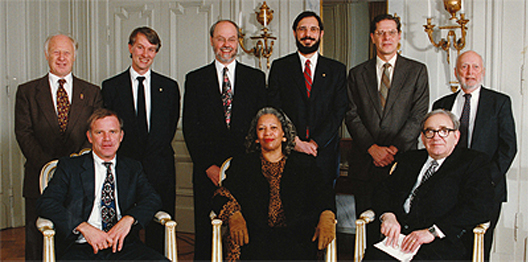 nobel prize winners 1993
No one knew exactly what lay ahead. In the late seventies, just as I started working for Cetus, a number of prominent molecular biologists convinced the rest of the field to hold off a little to ponder the safety issues. Conferences were called, laws were even passed in Cambridge, Massachusetts and Berkeley, California. We were safely in Emeryville, where there were gambling houses, but few laws. No one could be sure that putting human genes into micro-organisms that could possibly infect humans, was such a good idea. They never did figure it out, but by way of compromising, some strains of E. coli were designated to be more unlikely than others to be catastrophically destructive to humans, and we agreed to use only those.
E. coli K12 didn't solve my problem with the new oligonucleotide synthesis machine, neither did it solve the problem of rapidly determining whether or not the DNA of a growing fetus contained an unfortunate mutation, giving the parents an opportunity to elect an abortion.
Unconsciously combining the two problems, I started devising methods whereby oligonucleotides could be used to determine single base pair mutations from whole human DNA. Pregnant mothers should not have to wait for the cloners, and the result of running gels and using radioactive probes on genomic DNA were fuzzy for reasons mentioned above. Fuzzy is not a comfortable basis for making a life or death decision. Somebody needed to come up with a way to concentrate a single DNA locus in the presence of millions of similar but different DNA loci without the inevitable delay of cloning.
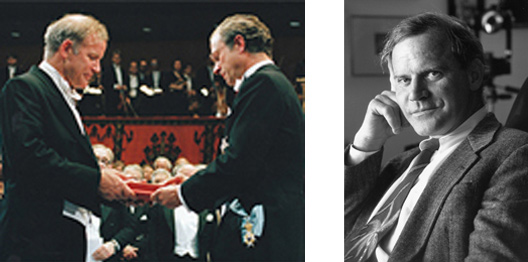
It was going to happen tonight. That somebody was going to be me. In ten years I would be toasting the health of the Swedish Royals in Stockholm, grinning from ear to ear at my good fortune.
The California buckeyes poked heavy blossoms out into Highway 128. The pink and white stalks hanging down into my headlights looked cold, but they were loaded with warmed oils that dominated the dimension of smell. It seemed to be the night of the buckeyes, but something else was stirring.
My little silver Honda's front tires pulled us through the mountains. My hands felt the road and the turns. My mind drifted back into the laboratory. DNA chains coiled and floated. Lurid blue and pink images of electric molecules injected themselves somewhere between the mountain road and my eyes.
I see the lights on the trees, but most of me is watching something else unfolding.
If a person were to attempt extending a synthetic oligonucleotide prepared to be complementary to a target on human DNA by just one base, using DNA polymerase and dideoxynucleoside triphosphates, using four different tubes each containing all four bases, but only one of them in each tube alpha-labeled with 32P, optimistically one might be able to discover the identity of the nucleotide on the DNA target just three-prime of the oligomer. Dideoxy-sequencing worked that way…but…Huge but…that only worked on cloned DNA where the ratio of target to non-target DNA was increased by a factor of about a million. Fortunately for me I was thinking about other things that might go wrong than just the brute improbability that only the right sequence would be engaged. I paid just enough attention to this hypothetical problem to plan on using two oligonucleotides, one designed for each strand of the target sequence coming at the base pair in question from either side. Although these two sides would be far distant in the denatured reaction mixture they would still represent complementary strands and if one told me that a 'T' was three-prime to one oligo, the other should have told me 'A' was three-prime to the other. Not much of a control, but I had oligos to burn. In fact that was what I was trying to do. We had excess oligos on our hands.
I was worried about another possible problem. What if the DNA sample, coming as it did from a person's tissue, was contaminated with deoxynucleoside triphosphates of its own. Not especially unlikely, and the sad fact was that DNA polymerase was not terribly fond of dideoxies, when the natural substrate was around. Very likely it would add a few deoxynucleotides to the proffered oligomer before getting around to the dideoxies, labeled or not. This would destroy the simplicity I was hoping for, a test that could be completed in one shift in a hospital laboratory. So I started thinking of ways to get rid of any possible stray nucleotides in the sample before I did the experiment.
There were at least three misconceptions driving me towards PCR. I was very close. But I didn't know what I was close to. I misconceived that I was just solving some little technical detail. Good. I didn't clutch. I don't think normal people can look directly at something that is going to have a huge effect on them. We are better creeping up from the side.
My second misconception was that the procedure I was planning would work at all. The probabilities of the complexity of the sample, which PCR was going to solve very shortly, were very much against it. I drove on.
The third misconception was more subtle and was shared by my colleagues. There is an enzyme that could have disposed of the hypothetical stray deoxynucleoside triphosphates, bacterial alkaline phosphatase. It would clip off their little triphosphate tails in a flash, but then I would have to get rid of it, before I added my precious dideoxies, or it would clip off their tails, too. Everyone knew that BAP, as we referred to it, could not be irreversibly heat denatured, so you couldn't get rid of it easily. The discovery of the natural renaturation of heat denatured BAP was famous. It established that the three-dimensional structure of a protein would refold based on its sequence alone. There was a product called MAT-BAP on the market to get rid of BAP after it was no longer desired in a reaction, by having the protein attached to an insoluble matrix. I had never had any luck with this product, and neither I, nor anyone else in the field, realised that if you take a microliter of BAP from a commercial supply, and use it quickly, before it loses its zinc atom into a buffer that contains no appreciable zinc, it will work for a short time, and then it will be subject to irreversible heat denaturation. I discovered that much later, but fortunately did not know it at the time. The famous refolding experiment was done in a high zinc buffer.
So I considered other ways to get rid of deoxynucleoside triphosphates.
Klenow! That would polymerise them, given an oligomer to start with and some single-stranded DNA for a template. Klenow was the polymerase that I had planned to use anyhow. How clever. I would use it twice for two purposes. First I would denature my sample, separated into four tubes, add the primers I would later use in the main event, bring to 37 degrees and wait. The polymerase should polymerise all the nucleotides.
Now I would heat the mixture to remove the oligos that may have been extended indefinitely now, cool to 37 degrees, add some more polymerase which would have been denatured by the heat, and add the dideoxynucleotides. I had it…PCR, but I didn't see it yet.
There would be a vast excess of oligomers, now fresh ones would land on the target strands and hopefully be extended by one radioactive nucleotide. What could go wrong? What if the oligomers in the 'get rid of the triphosphates' step had been extended a long way?
I very quickly brought the Honda to a stop near the roads edge, but sticking out into the potential logging trucks. With me, my girlfriend still asleep, and my new invention in peril, I contemplated what would happen if they had been extended a long way. Their extension products would be primed by the other oligos and these would also now be extended.
I would have doubled the signal, and I could do that over and over, and I could add a tremendous excess of my own deoxynucleoside triphosphates as they are cheap, soluble in water and legal in California.
I'd better get out of the road.
A few hundred yards down 128 was a pullout. By the time I got there the rest had fallen grandly into place. I could design the oligos some distance from each other. After three cycles they would make a double stranded DNA molecule corresponding exactly to the DNA template between them, and that would double in concentration every subsequent cycle. Anything else that happened would be of no concern. After ten cycles I would have a thousand. I knew my powers of two, because I wrote computer programs I understood the power of reiterative loops. Thirty cycles would be somewhere around a billion. The product would overwhelm anything that was unintended because it would be self catalytic, and only the site of interest would bind the necessary two oligos together in their little reproductive dance.
I didn't sleep that night. The next morning I bought two bottles of Navarro Vineyards Pinot Noir, and by mid afternoon had settled into a fitful sleep. There were diagrams of PCR reactions on every surface that would take pencil or crayon in my cabin. I woke up in a new world.
Downloads & Links

Some Questions About PCR
How has PCR affected the medical world?
Far less than it has affected the medical journalistic world. The last time I was seriously hospitalized with coronary artery problems was 2004 and there was plenty of testing of blood and imaging work, but information about my DNA was not considered. This is still in the stage of research. It will become more and more a part of medical practice, since individual tolerance and susceptibility to certain drugs, like heparin for instance, is significant and connected to DNA genotype. Personalized medicine is coming. It is still in the research stage.
Transfusions of blood and organs are monitored for histo-compatibility using DNA types, and several genetic disorders as well as infectious diseases are certainly examined at the DNA level.
There is much more to come than has been applied. Practical medicine necessarily moves more slowly than medical research.
How did your life change after winning the Nobel Prize?
My favorite pastime is learning according to the directions I discover for myself. Having a Nobel Prize allows one to indulge this kind of habit without starving, and I have taken advantage of it. Some people are not so obsessed with their own freedom, and utilize the awarding of a Nobel as a gateway to power and responsibility, and the accompanying financial rewards. I don't accept responsibility easily and I am happy without those things. I like to read widely and at my own direction. Having a Nobel Prize has allowed me the opportunity to become well enough educated that I feel now that I really deserve one.
Tell us about this new discipline paleobiology?
It's not a new discipline, just newly invigorated. I had the good fortune to work down the hall from the great paleobiologist Allan Wilson when I was a graduate student at Berkeley and Allan was struggling with established conceptions about human origins and evolution in general. He needed better ways to measure real evolutionary distance than immunology provided, and I was thrilled to provide him with PCR, and he was thrilled to begin using it in his lab, which was one of the first to put it to any real use.
He thought I should have called it "in vitro cloning." I liked "Polymerase Chain Reaction.. The discipline of paleobiology would certainly not care to part with it now, under any name.
In your opinion what is the point where science meets with business. How can business affect the world of science?
I have never encountered a business person with any true interest in science. Why should he be interested? He had the choice, and he chose business. It is only through good fortune that money ends up in the hands of scientists, who know how to use it for anything other than making more money, and it is a sorry situation indeed, since much scientific research is not cheap.
Sometimes very fortunate scientists get rich, like Craig Venter, and then they can let their imagination direct their research, but this is the rare exception. Most scientists are constrained to do the bidding of businessmen, and it can be immensely frustrating for the scientist and unproductive for society in general. Most biological research ventures fail because the boss is highly subject to scientific illusions and has no idea how to separate truly good ideas from the highly simplified and often distorted things that filter up to him. He is usually under the influence of even less informed investors, and subject to misinformation from inferior scientists eager to have his favor. It is an unsavory world which I have never enjoyed.
As has been known for millennia "philosopher kings" are hard to come by Government grants, although offering, in theory, a preferable alternative, have the similar problem of being often administered by scientific incompetents who are after power and personal security, instead of widely useful knowledge. Good scientists don't like administrative jobs, which leaves us exactly where we are. Science is generally directed by non-scientists.
We stumble on.
Questions from Maria Vasilescu